Most developers and architects don’t run into passive fire problems on greenfield projects. They run into them on the others: refurbishments, change-of-use projects, acquisitions, and staged developments. That is where legacy passive fire installations live, and where they quietly become the next project’s problem.
Legacy passive fire is one of the most underestimated risks on existing buildings. It rarely shows up in due diligence and is often invisible until ceilings come down, by which point the program is locked in and the design is committed. This article covers why legacy installations are so often non-compliant, what current obligations require, and how to approach a building where the passive fire history is unknown.
A short primer on passive fire
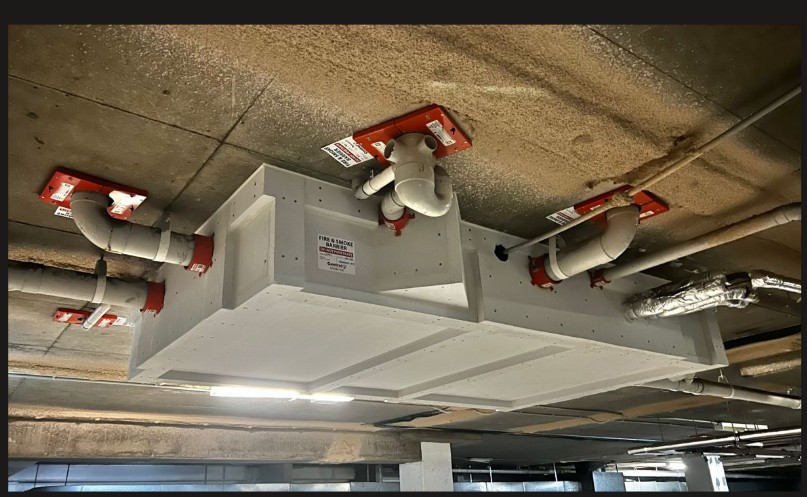
Passive fire protection is the part of a building that contains a fire rather than fighting it. Sprinklers and detection are active systems that respond to fire. Passive systems are built into the structure: fire-rated walls, floors, doors, dampers, and the firestopping that seals every penetration through them. Their job is to hold a compartment intact long enough for occupants to evacuate.
The NCC sets out the fire resistance levels (FRLs) walls and floors must achieve, expressed as three numbers (structural adequacy, integrity, insulation, in minutes). A wall rated -/90/90 must hold back fire and prevent dangerous heat transfer for 90 minutes. That rating only holds if every penetration through the wall has been fire stopped using a tested system that achieves the same FRL, installed exactly as the test report describes. Passive fire is a tested system, not a product. This is where legacy installations almost always come unstuck.
“Passive fire is a tested system, not a product. Substitute the sealant, change the configuration, install in the wrong substrate, and the rating no longer applies.”
Why legacy installations are so rarely compliant
Existing buildings carry the accumulated history of every services upgrade, fit-out, and patch made over their life. Each typically involved penetrating fire-rated elements. The reasons compliance breaks down are consistent across almost every building we inspect.
The tested-system landscape has changed
Test methods, accepted systems, and product approvals have evolved. An installation that was compliant under an earlier NCC edition may no longer be evidenced by any current tested system. The product may still be on the market, but the specific configuration installed may no longer have a current test certificate. Without that evidence, a certifier cannot accept it.
Documentation is almost never complete
On older buildings, original firestopping documentation has usually been lost or was never produced and updated as a result in changes in the building. There is rarely a penetration register or photographic record. So even where the installation is compliant, there is no evidence trail to support it.
Multiple trades, multiple eras, no single owner
Every services upgrade produces new penetrations, and accountability for sealing them fragments across decades. We routinely find penetrations drilled by one trade, run by another, and never sealed at all. We find others sealed with intumescent sealant slapped over a hole with no backing rod, no substrate verification, and no resemblance to a tested system.
“Even where a legacy installation is competent, without a current tested system and an evidence trail to support it, a certifier cannot accept it.”
Why this matters more in 2026
For a long time, legacy passive fire was treated as an inherited condition. That tolerance has narrowed. Regulators have tightened expectations around documentation and accountability for building work, with named designers, named builders, and audit powers that didn’t exist a decade ago. Certifiers are far less willing to accept undocumented passive fire on the basis that it looks reasonable, and insurers and owners’ corporations are commissioning more thorough fire safety reviews.
For developers, this changes the risk profile of any project on an existing building. Legacy passive fire can no longer be papered over at handover; it needs to be inspected, evidenced, rectified where required, and documented in a way a third party can rely on. For architects, it changes what the design needs to anticipate, particularly around demolition extent, services routing, and ceiling access during construction.
“Legacy passive fire is no longer an inherited condition you note and move past. It is a documented, evidenced compliance task on every project.”
How to approach legacy passive fire on a project
1. Treat it as due diligence, not a construction-phase issue
The most expensive way to discover legacy passive fire problems is to find them after framing is up and ceilings are about to close. On acquisitions and refurbishments, a passive fire audit belongs alongside the structural, services, and hazardous materials reviews. The findings will affect demolition extent, service relocations, and the design of new compartment boundaries.
2. Inspect against tested systems, not impressions
A surface-level walk-through is not enough. Legacy passive fire inspection means lifting access panels, opening ceilings strategically, and comparing every penetration through a fire-rated element against a tested system that matches the substrate, service, configuration, and required FRL. Where no tested system matches are available, the installation should be considered non-compliant by default, regardless of how well it was done.
3. Document defects in a form that can be used on site
A defect register full of test report numbers is not useful to a contractor with a caulking gun. Each defect needs to be tied to a specific rectification: which tested system, which product, which configuration, photographed before and after. This is the document the installer works from, and the document the certifier wants to see.
4. Build a verification trail as you go
Every penetration should be uniquely identified, photographed before close-up, tied to a tested system, and recorded in a register. Without this evidence trail, the next refurbishment in ten years will be back where this one started.
The creation of an accurate register also assists the building owners with their legislated routine service obligations.
“The most expensive way to discover legacy passive fire problems is to find them after ceilings are about to close. Move the work earlier, and most of the cost goes away.”
In practice: A Mosman residential and mixed-use project
To make this concrete, here is how it played out on a recent project: a six-storey residential and mixed-use development in Mosman, with a mix of Class 2 (residential), Class 6 (retail), and Class 7a/7b (carpark and storage) occupancies. That mix meant multiple compartment boundaries with different FRLs, and a building history that included earlier-stage works whose passive fire status was unclear.
The developer engaged Credwell because they needed clarity on the existing installations before construction progressed further. The picture was a familiar one: incomplete and inconsistent firestopping documentation, legacy installations that didn’t align with current NCC requirements or any current tested system, multiple subcontractors with no single point of accountability, and fire test reports that existed but had not been translated into site-ready details. Construction needed to keep moving while rectification was scoped.
Credwell carried out structured site inspections across multiple levels, comparing what was installed against the relevant fire test reports. Rather than producing a defect list and walking away, we worked on site with the contractors, explaining why each defect mattered and what a compliant rectification looked like. Reporting was written for site use, with clear photographs and rectification guidance tied to specific tested systems rather than generic product names. Rectification was sequenced level by level so completed work could be closed up while work elsewhere continued.
The outcome
- A clear path to compliance. Every fire-rated penetration assessed against a current tested system, with non-compliant work identified, scoped, and rectified.
- Fewer surprises at certification. The certifier received documented evidence rather than assurances, removing the usual late-stage friction at handover.
- Program protected. Rectification was sequenced level by level alongside other trades, so completed work could be closed up without holding up the rest of the build.
- Site-ready documentation. Contractors worked from clear, photographed details tied to specific tested systems, not generic product datasheets.
- A durable evidence trail. A penetration record that supports the certifier today and the owners corporation, insurers, and any future works for the life of the building.
The lesson: legacy passive fire problems compound when deferred. Bringing structured inspection, tested-system verification, and site-ready documentation in at the right time turned what could have been a contested handover into a managed sequence of works.
“Brought in early enough, what would have been a contested handover became a managed sequence of works.”
How Credwell helps
Credwell works with developers and architects on projects where passive fire history is uncertain, contested, or known to be non-compliant: early-stage audits on acquisitions and refurbishments, defect inspections across staged construction, tested-system verification, site-ready rectification documentation, and the evidence trail required at handover.
Our approach is technical by trade, practical in delivery, with safety always at the core. If you are looking at a building where the passive fire history is unclear or working on a project where legacy installations are slowing the program down, the earlier we are involved, the more we can do.
If you would like further information about our Passive Fire Services, please contact our Passive Fire Consultant – Nafi Shad.